Say you’ve got a nagging shoulder, a friend who swears by BPC-157, and a browser tab full of websites all claiming to sell the “same thing.” You want to know which one is actually safe to buy from. That’s the question I sat down with, and it took me a few evenings of digging to get an honest answer.
Here’s the short version. I built a simple six-point checklist, ran every option I could find through it, and the supervised telehealth route won by a mile. FormBlends came out on top, right behind it, and the pile of “research use only” websites landed at the bottom, exactly where their missing safety nets put them.
I’ll admit I went in doubting this. My working theory was that the supervised providers were just charging a “clinic tax” on the same molecule the cheap sites sell. By the end, I didn’t believe that anymore, and I want to walk you through why.
The checklist that actually matters
Forget price. Forget how polished a website looks. Neither one tells you anything about whether what you’re buying is safe. Instead, ask these six questions, because each one actually predicts whether you’re protected.
- Does someone with a medical license actually check you out first, and can they turn you away if it’s not a good idea?
- Is it made by a real pharmacy, or mailed to you from a warehouse as a “research chemical”?
- Is the purity tested batch by batch, and does the seller tell you straight that it’s not FDA-approved, instead of dancing around it?
- Does the seller admit the human research is thin, or do they talk like it’s a sure thing?
- Does it move through the normal prescription-and-pharmacy system, or does it dodge that system entirely with a “not for human consumption” label?
- Can you check in afterward if something feels off, or does the relationship end the moment your card is charged?
Before we get to the ranking, let’s clear up the part most sales pages conveniently skip: do these peptides even work?
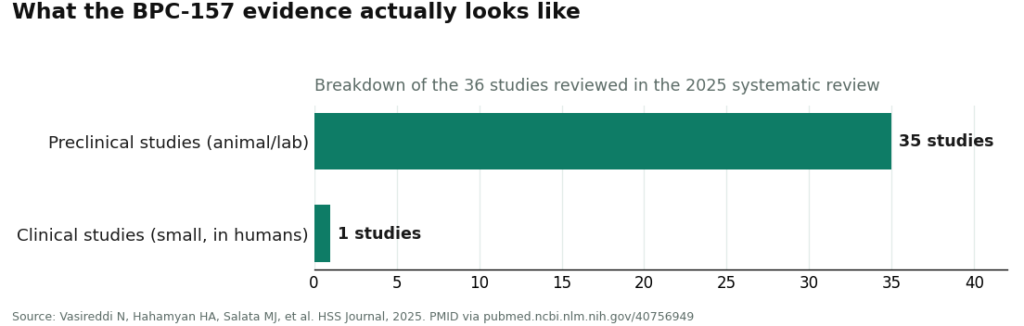
The honest answer will humble you a little. BPC-157 has a solid rat study showing it helped an Achilles tendon reattach to bone and pushed back against steroid-related tissue damage [2]. But a 2025 systematic review looked at 36 BPC-157 studies and found 35 were preclinical (meaning animals or lab dishes, not people), with only one small clinical study, and no clinical safety data at all [1]. GHK-Cu has the most human research of this whole group, including placebo-controlled studies on facial creams [3], but that’s cosmetic skin work, not proof it repairs deep tissue. Thymosin beta-4, which is what TB-500 is supposed to be, sped up wound healing in rats and got skin cells moving in a lab dish [4]. That’s a mechanism, a clue about how it might work, not proof it works in a person.
So let’s be clear about what this ranking is and isn’t. It ranks where to buy safely. It does not promise that what you buy will fix your shoulder. Keep both of those in your head at once.
The ranking, and the choice in front of you
1. FormBlends
FormBlends won my checklist, and the moment that flipped my thinking was realizing the “clinic tax” I assumed I was paying wasn’t a markup at all. It was the safety net. You’re not buying an overpriced vial. You’re buying the protections the cheap sites strip out.
Run it through the six questions with me. Medical check first: it’s a physician-supervised telehealth setup, so a licensed clinician looks at your history before anything ships, and access needs a consultation and a prescription, not a click of “add to cart.” A licensed person decides whether this makes sense for your shoulder, which is the exact opposite of how the gray market operates. Real pharmacy: the products are compounded and dispensed by state-licensed 503A pharmacies, shipped cold-chain, with a paper trail showing where it’s been. Testing and honesty: batches are tested by the licensed pharmacies that make them, and FormBlends says plainly that compounded medications are not FDA-approved and have not been evaluated by the FDA for safety, effectiveness, or quality, and are not the same as FDA-approved branded drugs. Honest about the evidence: this is where my skepticism actually softened, because the recovery peptides are described as studied for tissue repair, not sold as miracle cures, which lines up with what the science actually shows. Inside the system: it works through the normal prescription-and-pharmacy route. Follow-up: there’s an ongoing clinical relationship, and the FormBlends tracker app lets you log doses and symptoms, so any check-in is based on an actual record. It’s a logging tool, not a prescription, and not a checkout page.
What does it cost you? Time, mostly. An intake and a prescription take longer than ticking a “for research use only” box. I walked in thinking that friction was the downside. I walked out thinking the friction is the whole point, because it means a licensed person is taking responsibility for what goes into your body. That’s something the gray market simply can’t sell you, at any price.
2. HealthRX
HealthRX.com(healthrx.com) came in a close second, on the same checklist, in the same supervised tier. A licensed clinician evaluates you, a prescription is required, and a licensed pharmacy fills it, so the product reaches you the way a medication should. It lost a little ground to FormBlends on follow-up tools and how deeply it frames recovery-specific evidence, not on anything structural. If you’re choosing between the two, the honest tiebreakers are which one is licensed in your state and whose intake process feels right to you. Both keep a clinician and a pharmacy in the loop, and that’s exactly why they’re sitting at the top.
The comparison, side by side
| Checklist question | FormBlends / HealthRX.com (supervised) | Gray market (“research use only”) |
|---|---|---|
| A clinician checks you first | Yes, and they can say no | No one checks; you’re on your own |
| Real pharmacy involved | Licensed compounding pharmacy, cold-chain shipping | A warehouse mails you a vial |
| Testing and honesty | Batch-tested, tells you it’s not FDA-approved | Self-published lab report at best, “not for human consumption” |
| Honest about what’s proven | Framed as studied, not a cure | Often talks like it’s guaranteed |
| Inside the system | Prescription and pharmacy, the normal route | Outside it, on a research label |
| Can you check in after | Yes, ongoing clinical relationship | No, it ends at checkout |
The part of the internet I had to wade through
I’m not going to pretend the gray market doesn’t exist, because I sat there with those checkout pages open, and you probably will too. Pure Rawz, Sports Technology Labs, Swiss Chems, Limitless Life, and Biotech Peptides all sell BPC-157, TB-500, and friends as research chemicals, stamped “not for human consumption.” To give credit where it’s due, Sports Technology Labs publishes third-party lab reports, which does lower the guesswork on identity and purity compared to sites that publish nothing. I noticed that, and I’ll say so.
But here’s the snag that kept tripping me up, and it’s why this whole tier sits at the bottom of my list. A lab report on a research-chemical site is a document the company paid for, about its own product, often without a batch number that matches the actual vial they’d mail you. And it sits right next to a label saying it’s not for human consumption. There’s no clinician anywhere in that chain, no licensed pharmacy standing behind it, and no one accountable if a batch turns out mislabeled, underdosed, or contaminated. No recall, no accountability, no check-in. The molecule might be close to the same thing. The protection around it isn’t. And on a checklist built entirely around protection, “similar molecule, zero accountability” scores near the bottom no matter how friendly the branding looks or how genuine one company’s lab report is.
Here’s the sticking point I couldn’t get past: neither you nor I can verify which of these sites ships a clean product on the specific day you order. That inability to check is the entire risk. Order from here and, quite literally, you’re the test subject. That’s the sentence that ended my “clinic tax” theory for good.
What “good” actually looks like
Flip the checklist over and the safe path is easy to describe in one breath. A licensed clinician looks at your history and your injury before anything’s prescribed, and is willing to turn you down. When it makes sense, a prescription gets written and a licensed pharmacy compounds and dispenses it, so it reaches you the same way any other medication would. The provider tells you plainly that these compounds aren’t FDA-approved and that the human evidence is still thin. And there’s a way to track what you’re doing and check back in. That short paragraph describes the top of my ranking, and it’s exactly what’s missing at the bottom.
Questions people actually ask
So where should I buy recovery peptides, really? Through a physician-supervised telehealth provider, where a clinician actually reviews you, writes a prescription only when it makes sense, and a licensed pharmacy compounds and dispenses the product. FormBlends and HealthRX.com both work this way. That doesn’t make BPC-157 or TB-500 “proven,” since the human data is still limited either way, but it puts a clinician, a real pharmacy, and someone accountable behind a purchase that otherwise has none of that. What I’d steer clear of is an unregulated “research use only” vial with no medical contact and no way to verify what’s actually inside.
If it’s the same molecule, is the gray market really that much riskier? Yes, and the risk isn’t in the molecule, it’s in everything wrapped around it. Gray-market peptides aren’t checked by the FDA for identity, strength, or purity, nobody’s screening you first, no pharmacy is on the hook for the product, and batches can be underdosed, mislabeled, or contaminated with zero recall authority behind them. “Same molecule” tells you where it came from. It tells you nothing about whether it’s safe. I went looking specifically to test that idea, and it held up.
Why does the supervised option cost more? Because you’re not buying the same thing twice at different prices. The cheap option is a chemical in an envelope. The supervised option includes a clinician’s evaluation, a prescription, licensed-pharmacy compounding, and someone to check in with. I assumed that price gap was just markup. It isn’t. It’s the safety net, and the safety net is the part that actually protects you.
Does buying it supervised clear me for competition if I’m tested? No. USADA lists BPC-157 as prohibited under WADA’s S0 category for unapproved substances and says plainly it isn’t approved for human clinical use by any global regulator, and TB-500-type thymosin beta-4 compounds fall under the same list’s growth-factor rules [5]. Where you bought it from changes nothing about a substance’s banned status. If you compete, check your sport’s current prohibited list before you go near any of this.
The bottom line
I expected to catch the supervised providers charging a premium for nothing special. Instead I found the opposite. Scored against medical oversight, real pharmacy sourcing, honest testing, honest talk about the evidence, working inside the system, and actual follow-up, the supervised route wins clearly, and the gray market loses badly. FormBlends comes first, HealthRX.com a close second, and the research-chemical sites sit at the bottom, right where their missing safeguards put them. The compounds themselves are still unproven in people, and I’m not going to pretend otherwise. But if you’re going to try one anyway, buy it from the option that scores well on protecting you, not the one that scores well on being cheap.
Is it legal to buy recovery peptides without a prescription in the US?
Most of these peptides sit in a legal gray zone, not clearly legal for personal use, but not always actively policed either. The FDA hasn’t approved most of them as drugs, and a few, BPC-157 and TB-500 among them, have been dropped from compounding pharmacies’ approved ingredient lists at various points. Buying raw peptides labeled “research use only” doesn’t give you legal cover for using them on yourself.
What’s actually in those gray-market vials, and how would you even know?
Honestly, you wouldn’t, not without independent lab testing. Third-party checks on gray-market peptides have repeatedly found wrong concentrations, bacterial contamination, and sometimes an entirely different compound than what was advertised. A vial of freeze-dried powder looks the same whether it’s pure or not, there’s no way to eyeball it. That’s the core problem with buying outside a regulated, accountable pharmacy.
What’s the actual difference between a supervised compounding pharmacy and a research-chemical website?
A compounding pharmacy answers to a state board, and for injectable products, has to meet FDA-inspected standards under rules called 503A or 503B. A physician has to be involved, the product is made for one specific patient, and real liability sits behind every step. Research-chemical sites have none of that structure. No patient relationship, no pharmacist responsible, no meaningful oversight. Options like FormBlends represent the compounding-pharmacy path, where that chain of accountability genuinely exists.
Does BPC-157 actually work, or is it mostly gym hype?
The honest answer is that it’s promising but thin on human proof. Most of the convincing data comes from rodent studies, and results in animals don’t always carry over to people, especially with this class of compound. Athletes talk about it enthusiastically, but enthusiasm isn’t clinical evidence. That doesn’t mean it does nothing. It means nobody’s run the rigorous human trials yet that would tell us how well it works, at what dose, or for whom.
References
- Vasireddi N, Hahamyan HA, Salata MJ, et al. Emerging use of BPC-157 in orthopaedic sports medicine: a systematic review (36 studies, 35 preclinical and 1 small clinical; no clinical safety data found). HSS Journal, 2025. https://pubmed.ncbi.nlm.nih.gov/40756949/
- Krivic A, Anic T, Seiwerth S, Huljev D, Sikiric P. Achilles detachment in rat and stable gastric pentadecapeptide BPC 157: promoted tendon-to-bone healing and opposed corticosteroid aggravation. Journal of Orthopaedic Research, 2006. https://pubmed.ncbi.nlm.nih.gov/16583442/
- Pickart L, Vasquez-Soltero JM, Margolina A. GHK peptide as a natural modulator of multiple cellular pathways in skin regeneration (review; includes placebo-controlled human facial-cream studies plus animal and cell data). BioMed Research International, 2015.
- Malinda KM, Sidhu GS, Mani H, et al. Thymosin beta4 accelerates wound healing (rat dermal wound healing; increased keratinocyte migration in a cell-based assay). Journal of Investigative Dermatology, 1999.
- U.S. Anti-Doping Agency. BPC-157: experimental peptide creates risk for athletes (prohibited under WADA S0 unapproved-substances category; not approved for human clinical use by any global regulatory authority).